 | 💡 Tip of the Week Did you know your AI companion can help create a Rulebook and Playbook that automatically will enhance its effectiveness and speed in every project? — your AI can draft them from your own history with it, and you just fill in the blanks. Open the AI tool you use most and paste this in: | "Based on everything you know about me and my business from our past conversations, help me draft two documents. First, a Rulebook that captures how my business works: who I serve, who I refuse to serve, my standards, my positioning, my priorities, and my non-negotiables. Second, a Playbook that captures how I think: my voice, my decision-making logic, my mental models, and the experiences that shaped my judgment. Pull from what you already know about me wherever you can. Then ask me targeted questions to fill in anything you're missing before you finalize them." |
Same tool you already pay for — now it's building the foundation that makes every future answer sound like you. Then upload those two documents to every new project, agent, and chat you start, and you'll instantly sharpen its effectiveness and save yourself hours of teaching it how to help you. | In This Issue1 | Why "we use ChatGPT" isn't a strategy |
2 | The shift: stop using AI, start building with it |
3 | The two documents that change everything |
4 | What to build first (a 2-minute test) |
| How to Stop Using AI and Start Building With It• 6 min read | | 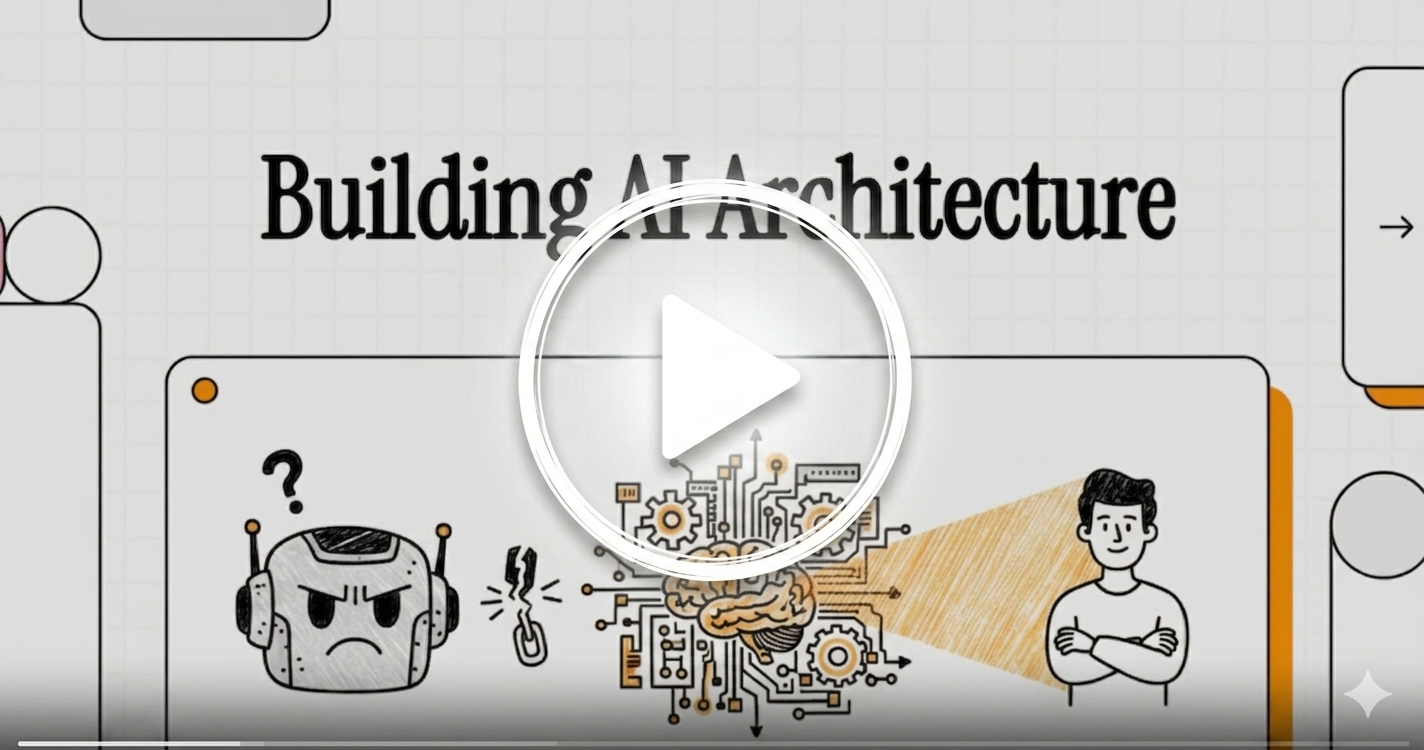 Watch this edition instead The shift from using AI to building with it — and the research agent in action | Play Video → |
|
| Most business owners I talk to have the same quiet experience with AI. They sign up. They ask it to write an email, a job post, a client update. It gives them something… fine. Generic. A little robotic. Not wrong — just not them. They tweak it, and may get the feeling: "AI is overhyped — at least for my business." |
And to be fair, it does help — chatting with AI makes you faster and more efficient. But it still leans on your input and never replaces your judgment. That's only a sliver of what AI can do now. Recently, I took a leap and stopped asking AI to do tasks for me and tried something different. I built my first real AI agent — a research assistant designed to do deep, complex research on any topic I hand it. But here's the part that mattered: I didn't just turn it loose. I gave it a rulebook and a playbook — written instructions for how I think, how my business actually works, and how I want it to work with me. I even built it to ask me questions when it needs to understand my goals before it runs. Then I tested it. I gave it one prompt: | "Research the current state of AI agents in 2026 — what are people actually using them for, what's working, what's overhyped, and where are things headed?" |
What came back wasn't a wall of text. It was a finished, organized dashboard. The difference between that and "write me a paragraph about AI" was night and day. Same technology. Completely different result. The difference wasn't the AI. It was the architecture I gave it. |
| | Why "we use ChatGPT" isn't a strategy Here's the uncomfortable truth most people miss: if your AI strategy is "we use ChatGPT," you don't have a strategy. You have a subscription. Imagine the only website you'd ever seen looked like it was built in 1997 — clunky and useless. You'd write off websites entirely. That's what's happening with AI: people get generic output, assume the tool is broken, and stop. But it's not the AI that's broken — it's how it's used. Generic in, generic out. It doesn't know your customer, your standards, or the result you want, so it hands you the average of everyone: mediocrity, just faster. A quick note before we go further: the frameworks in this edition — the levels of AI maturity, and the Rulebook/Playbook approach — are based on an amazing talk I recently attended by Sandy Wardenburg Waggett of MSW Interactive Designs. They stuck with me, and they map almost perfectly onto the way we think about building financial systems. Think of AI maturity in three levels: 1 | Acceleration — speed You chat with AI to work faster — write this, summarize that. Handy, but every chat starts from scratch and forgets you the moment you close it. About 95% of businesses live here. |
2 | Compression — efficiency AI stops helping with tasks and starts eliminating the ones that shouldn't exist. A workflow runs the ten steps and hands you the finished result — where AI stops being interesting and starts being operational. |
3 | Replication — leverage It doesn't just know what to do — it knows what you would do. Your judgment and voice are built in, so it runs work the way you would, even when you're out of the room. You, in ten places at once. |
| Quick take Most owners are stuck at Level 1 not because they're behind, but because nobody told them the other levels exist — or how to climb to them. |
| | The shift: stop using AI, start building with it Almost everyone asks the same question: How do we use AI? It's the wrong question. The better one — the one the top few percent are asking — is: How do we stop using AI and start building with it? "Using" is reactive. You type, it responds, you move on, and nothing compounds. "Building" is intentional. You create something that gets smarter and more you every single time you use it. If you've been reading The Profit Shift for a while, this should feel familiar. It's the exact same lesson we preach about your money: reacting to your bank balance every week is exhausting and gets you nowhere. Building a system — Profit First, clear allocations, real visibility — is what creates peace and progress. AI is no different. Systems beat scrambling. Every time. | | The two documents that change everything If you take only one thing from this edition, take this: AI is only as good as the rules and context you give it. The magic isn't in the prompt. It's in the foundation underneath the prompt. Two documents do the heavy lifting. 1 | Your Rulebook — how your business works The structured truth about your company: who you serve, who you refuse to serve, your standards, your positioning, your priorities, and your non-negotiables. When your knowledge becomes structured, it becomes leverage. |
2 | Your Playbook — how you think Your judgment, encoded: your voice, your mental models, your stories, how you make decisions. With this, the AI doesn't guess what you'd do. It already knows. |
Give an AI those two things and everything downstream changes. It stops sounding like a robot and starts sounding like you. It stops handing you the average answer and starts handing you your answer. | | What to build first — a 2-minute test You don't need to AI-ify your whole business this week. You need to pick the right first thing. Take any recurring task and drop it into one of four boxes: | DRIVE — high impact, needs your human touch This is where you're irreplaceable. Keep it. Don't hand off the work only you should do. |
| DEPLOY — high impact, repeatable Prime territory for an AI agent to own. Build here first. |
| DELEGATE — low impact, repeatable Set it up once, automate it, and stop thinking about it. |
| DUMP — low impact, needs a human Be honest: this task probably shouldn't exist at all. Stop doing it. |
Most owners start with the hardest, most human work (Drive) and get frustrated. Start with Deploy — the high-value, repeatable work that drains your week — and let a well-built agent carry it. | ✅ Try this week 1. Pick one repeatable task that eats your time and sort it into the four boxes above.
2. Write a one-page Rulebook for your business: who you serve, your standards, your non-negotiables. |
| Bottom Line | AI isn't your competitive advantage — your architecture is. Stop using AI and start building with it. It begins with two documents: a Rulebook for how your business works, and a Playbook for how you think. Structure your knowledge, and it becomes leverage. |
| | SCHEDULE A STRATEGY SESSION NOW! Adam Litster
Chief Profit Architect
(816) 500-5779
[email protected]
www.betterbizinfo.com Simple systems. Consistent profit. |
Presented by |
| Fractional CFO — Numbers → Strategy Pair deep financial insight with mentoring. We translate your data into decisions, set targets, and meet regularly to keep execution tight and make you smarter with your money. | ✓Profit and Cash Flow Strategy Profit First Implementation and maintenance | | ✓Pricing & margin analysis with clear thresholds | | ✓Monthly financial coaching to drive results |
Teach. Plan. Execute. Repeat. | |
|
|
|